
AI Agent Harness: A Practical Guide to Safer, More Reliable Business Automation
An AI agent harness controls context, permissions, verification, memory, and safety. This expanded practical guide uses credited diagrams to show how dependable business automation is designed.

Quick answer
An AI agent harness is the operating layer around a model: it supplies context, governs tool access, retains state, runs verification, and stops unsafe actions. If you want an agent to work reliably in a real business workflow, the harness matters as much as the model you choose.
The practical question is not “Which model is smartest?” It is “What is this model allowed to do, what evidence must it produce, and when must a person decide?”
What an agent harness does
A useful shorthand is:
Agent = model + harness
The model reasons over the task. The harness turns that reasoning into controlled work. It connects the model to files, applications, databases, browsers, and business rules - while also defining the limits around each connection.
For a customer-operations agent, the harness may decide that the agent can read an inquiry, prepare a CRM update, and draft a reply. It may also prevent the agent from sending the reply, editing billing data, or exporting customer records without approval.
That difference is what separates a helpful workflow assistant from an uncontrolled automation risk.

The model supplies reasoning; the harness provides the operating environment that turns reasoning into controlled work. Visual from Alex Prompter's original harness-engineering article; included with attribution for explanatory context.
Why model quality alone is not enough
Better models can make stronger plans and produce better drafts. They do not automatically know your current business rules, your data boundaries, or which exception requires human judgment.
A capable model with broad, unverified access can make a costly mistake quickly. A more modest model with clear permissions, narrow tools, and fast checks can be safer and more useful in production.
The goal is not to slow every agent down. It is to make low-risk work easy and high-impact work deliberately hard.

The credited source visual traces how harness engineering evolved from evaluation tooling into a broader agent-systems discipline. See Alex Prompter's original harness-engineering article for the source context.
The six layers of a practical harness
1. Context: give the agent the right operating brief
Agents need durable, current instructions outside the chat window. A good brief explains:
- the business objective and success criteria
- the systems and files that are in scope
- the expected format for outputs
- rules learned from earlier failures
- escalation paths and named owners
In a software project, this often lives in files such as AGENTS.md or CLAUDE.md. In a business workflow, the equivalent may be a process guide, an approval matrix, and a shared knowledge base.
Keep it specific. “Handle leads professionally” is vague. “Create a draft record, flag missing phone numbers, and require approval before sending a proposal” is actionable.

A permission model should differentiate routine actions from public, destructive, or high-consequence actions. Visual from Alex Prompter's original harness-engineering article; included with attribution for explanatory context.
2. Permissions: control actions by consequence
Do not treat every tool call as equal. Reading a public webpage, updating a draft, sending a message, changing production data, deleting files, and granting access have very different consequences.
Set permission boundaries by action, not by vague trust in the agent. A sensible starting point is:
| Action | Default policy |
|---|---|
| Read approved knowledge and public sources | Allow |
| Create drafts and internal tasks | Allow with logging |
| Update reversible internal records | Allow with verification |
| Send customer messages, publish content, or change production data | Require approval or an explicit policy |
| Delete data, move money, grant access, or export sensitive data | Block by default; require a human decision |
This makes the workflow auditable and reduces the chance that convenience becomes silent authority.

Fast checks let agents correct earlier; human review remains important for judgment-heavy or high-impact work. Visual from Alex Prompter's original harness-engineering article; included with attribution for explanatory context.
3. Verification: make “done” testable
An agent reporting success is not evidence that work succeeded. The harness must check the result against a real condition.
Examples:
- A coding agent runs tests and a build, then reports the exit status.
- A content agent confirms the public article page loads and the correct title appears.
- A CRM agent reads the saved record back after writing it.
- A finance agent validates totals and requires approval before payment.
Use the fastest reliable check available. Small validations close to the action catch errors before they spread into a larger workflow.

Progress logs, task lists, and rulebooks preserve state across fresh agent sessions. Visual from Alex Prompter's original harness-engineering article; included with attribution for explanatory context.
4. Memory and state: keep important work outside the context window
A long-running agent needs durable state: a plan, completed steps, evidence, decisions, and unresolved blockers. Store that state in files, databases, task records, or version control - not only in a transient chat.
This makes work resumable and reviewable. It also prevents an agent from repeatedly rediscovering the same constraints.
A simple rule works well: if the next operator needs it to continue safely, save it where they can inspect it.

Safety controls must account for how a command actually executes, not merely how it appears as text. Visual from Alex Prompter's original harness-engineering article; included with attribution for explanatory context.
String matching alone is fragile; parsing and enforcing command semantics creates a stronger boundary. Visual from Alex Prompter's original harness-engineering article; included with attribution for explanatory context.
5. Safety boundaries: use real controls, not text-only warnings
Instructions can be missed or misinterpreted. High-impact safeguards should be implemented as actual boundaries:
- sandboxed file systems or disposable environments
- allowlisted tools and API scopes
- approval gates for public or irreversible actions
- secret isolation and redaction
- backups, version control, and rollback paths
- command parsing that reflects how the system will actually execute a command
A warning that says “do not delete production data” is helpful. A permission system that cannot delete production data without an approved token is stronger.

A mature harness converts a discovered mistake into an environment rule that prevents the same class of failure. Visual from Alex Prompter's original harness-engineering article; included with attribution for explanatory context.

A concise operational rulebook gives future runs the benefit of past lessons. Visual from Alex Prompter's original harness-engineering article; included with attribution for explanatory context.
6. Learning loop: convert mistakes into operating rules
Every meaningful failure should improve the environment. Capture what happened, why the existing controls did not catch it, and what rule, test, permission boundary, or process change will prevent a repeat.
This is how an agent system becomes more dependable over time. Retrying the same task with the same conditions is not a fix.

Different teams may implement differently, but durable state, verification, and structural safeguards are common foundations. Visual from Alex Prompter's original harness-engineering article; included with attribution for explanatory context.
A 30-minute harness audit for your first business agent
Before connecting an agent to a real workflow, answer these questions:
- Scope: What exact outcome is the agent responsible for?
- Inputs: Which sources can it read, and which must remain unavailable?
- Actions: Which actions are reversible, public, financial, or destructive?
- Approvals: Who approves each high-impact action, and where is that approval recorded?
- Verification: What observable check proves each action worked?
- Recovery: How do you roll back, correct, or escalate a failure?
- Learning: Where will you record the rule that prevents this failure next time?
If you cannot answer these questions clearly, the agent is not ready for unsupervised access.

Separation of planning, execution, and evaluation improves review quality and gives each stage a clear contract. Visual from Alex Prompter's original harness-engineering article; included with attribution for explanatory context.
An example: lead follow-up without handing over the inbox
Consider an agent that helps a sales team follow up on inbound leads.
A weak setup gives it access to the inbox and asks it to “handle follow-ups.” A practical harness instead lets it:
- Read new inquiry messages from approved sources.
- Extract the lead details into a draft CRM record.
- Identify missing information and prepare a personalized response.
- Check the draft against messaging and compliance rules.
- Queue the response for a salesperson to approve.
- Log the decision and the final message after it is sent.
The team still gets faster response times and cleaner records. The agent does not silently make commercial commitments on the company’s behalf.
Practical takeaway
The model is the reasoning engine. The harness is the operating system that determines what that reasoning can access, change, and claim to have completed.
Start narrow, define permissions by consequence, verify every meaningful side effect, and make each failure improve the controls. That is how AI agents become useful business infrastructure rather than impressive demos.
Four harness patterns worth borrowing
The visual examples above point to four complementary ways to build dependable agents. They are not competing product recipes; they are design patterns a business team can adopt selectively.
Separate planning, execution, and evaluation
A single agent can plan, act, and declare its own work complete. That is convenient, but it concentrates too much trust in one context. For work that affects customers, code, or operations, divide the flow:
- A planner turns the objective into a bounded task list.
- An executor performs only the approved actions.
- An evaluator checks evidence against the acceptance criteria.
- A human owns any exception that crosses a risk boundary.
This does not require four different tools. It requires clear contracts and a fresh check that is not simply the original agent agreeing with itself.
An example of separated agent roles from Alex Prompter's original harness-engineering article. The Pratap AI interpretation: split responsibility where independent verification matters.
Keep the working truth in the repository or operating record
A useful agent should not depend on remembered conversation fragments alone. Store requirements, task progress, decisions, evidence, and rules in the project repository or the equivalent business operating record.
That gives a new session the same starting position as the previous one. It also makes a manager able to inspect what the agent was told, what it changed, and why it stopped. For business automation, the equivalent may be a CRM record, a workflow run log, an approval record, and a concise exception queue.

Repository-local artifacts shown in the credited source article. The same principle applies to business workflow records and approval logs.
Treat productivity controls and safety controls differently
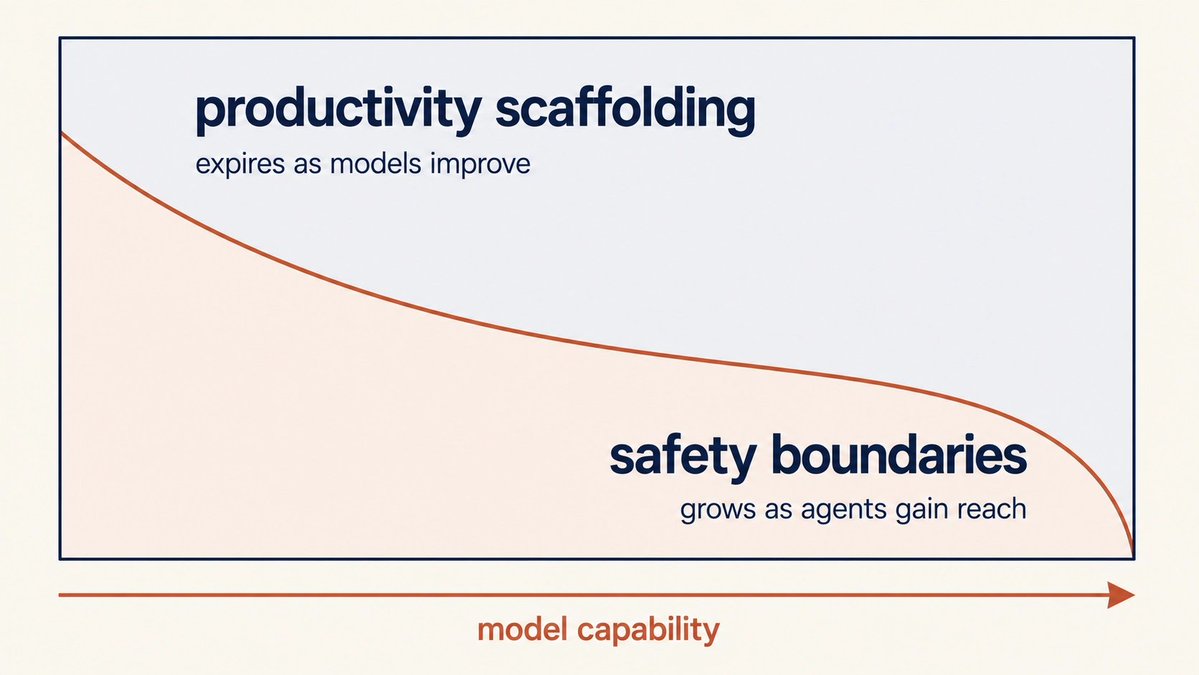
As models improve, some scaffolding can become lighter: more detailed task decomposition, repeated formatting instructions, or manual prompting rituals may no longer add much value. Safety controls are different. Broader capability and persistence make least privilege, review gates, and rollback more important - not less.
The practical rule is simple: remove friction that only compensates for weak capability, but keep controls that limit irreversible consequences.

Conceptual trade-off from the credited source. Capability can reduce some process overhead while raising the importance of firm safety boundaries.
Make the harness measurable
A harness is not complete because it exists. It should produce evidence that it is working. Track:
- actions automatically completed versus actions escalated
- validation pass and failure rates
- time spent in a blocked or retrying state
- rollback events and corrected records
- recurring failure categories and the rules added to prevent them
- human-review outcomes for high-impact actions
These measures show whether the system is becoming more dependable or merely more active.
A practical rollout sequence
For most teams, the right first harness is deliberately small:
- Choose one repetitive workflow with a visible owner.
- Allow the agent to read only the sources needed for that workflow.
- Limit it to draft creation and reversible internal updates.
- Add an observable verification step after every write.
- Route external, financial, sensitive, destructive, and access-changing actions to approval.
- Record every exception and add the smallest durable rule that prevents recurrence.
- Expand permissions only after the evidence shows the narrower version is dependable.
This approach creates useful momentum without confusing a successful demo for a production-ready operating system.
FAQ
What is the difference between an AI agent and an AI agent harness?
An AI agent uses a model to plan and perform tasks. The harness is the surrounding infrastructure that supplies context, tools, permissions, memory, verification, and safety controls.
Do small businesses need an agent harness?
Yes, but it does not need to be complex. Even a simple agent should have clear scope, limited access, a review step for public actions, and a way to verify and correct its work.
Should every agent action require human approval?
No. Routine, reversible, low-risk actions can be automated with logging and checks. Human approval is most valuable for external, irreversible, financial, sensitive, or high-reputation actions.
What should I build first: the agent or the harness?
Design the operating boundaries first, then connect the agent to the smallest useful workflow. The agent and harness evolve together, but permissions, verification, and recovery should not be an afterthought.
This article is an original Pratap AI interpretation of the agent-harness discussion in Alex Prompter's X article. The source article and its cover image are credited for context; the operational guidance above is independently written for business teams.
Recommended reads
What Should You Use AI Agents For? A Practical Founder’s Playbook
The best way to use AI agents is not to start with models or tools. Start with repeated work, low-value admin, research loops, and personal friction points you already understand, then give agents narrow jobs with clear review steps.
Semantic Memory Substrate: Why AI Agents Need Shared Company State
A company brain is not another app that remembers things. It is a shared semantic memory substrate that lets humans and AI agents work from the same facts, decisions, permissions, and history.