
Graph Engineering: How to Design AI Workflows That Scale With Control
A practical guide to graph engineering: map real dependencies, run independent work in parallel, use structured handoffs, and keep AI workflows governed by verification and accountable human review.
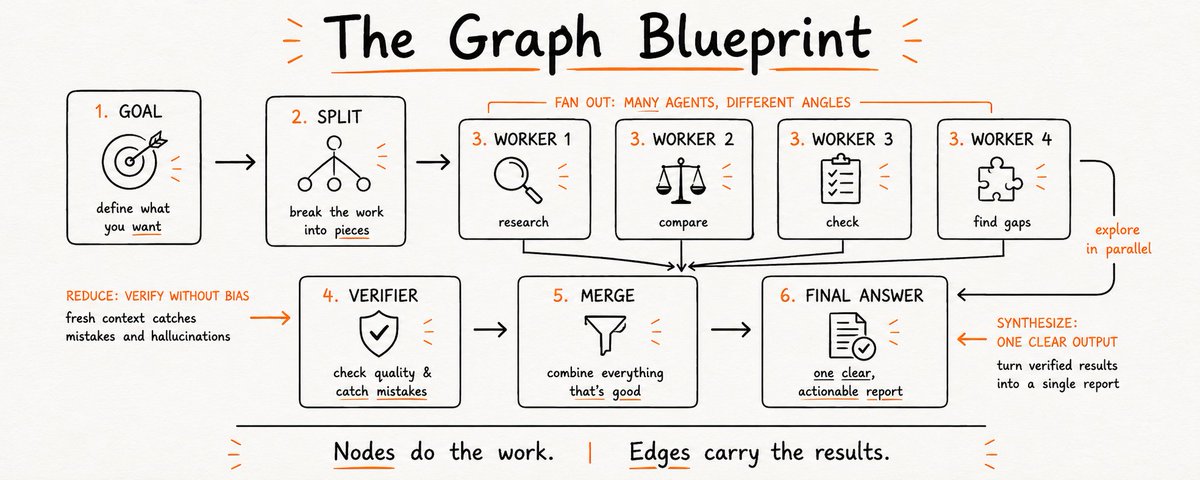
Graph engineering is the disciplined design of an AI workflow as a connected system of bounded jobs, explicit dependencies, and measurable controls. It is not simply “using more agents.” It is deciding which work can proceed independently, which outputs must be verified before they move forward, and where a human decision belongs.
For leaders, the value is operational rather than theatrical: a well-designed graph can shorten cycle time, improve coverage, and make responsibility visible across work that would otherwise live in inboxes, chat threads, and individual memory. It does not create judgment by itself. It creates a better structure for applying judgment consistently.
A note on this article: This is an original Pratap AI interpretation of ideas discussed in Anatoli Kopadze’s source article on X. The visual references below are used with visible attribution to that source.
Why graph engineering matters now
Many AI workflows are built as a straight line: research, draft, review, revise, publish. Linear workflows are easy to explain, but they often force independent activities to wait unnecessarily. A market scan may need competitor research, customer-language analysis, pricing review, and technical feasibility checks. Those streams can often run in parallel before they are reconciled into a decision.
The practical question is not whether a workflow looks sophisticated. It is whether its sequencing reflects the real work. If two tasks do not depend on the same input, they should not be queued simply because they were written in that order.
That distinction changes how a business uses AI. Instead of asking one assistant to work through a long checklist, a team can design a coordinated system that gathers evidence in parallel, applies targeted checks, and produces a single accountable output.
Visual source: Anatoli Kopadze, X.
A graph has only two essential parts
A graph is a map of work.
- Nodes are bounded units of work. A node may research a competitor, check a claim, classify an incoming enquiry, prepare a first draft, or validate that a required field is present.
- Edges are the real handoffs between those units. An edge exists only when one node requires an output from another node before it can proceed.
The important word is real. A workflow diagram is not useful if it represents habit rather than dependency. If one task has no need for another task’s result, the connection between them is artificial. Removing that artificial edge is often the simplest way to reduce latency.
For an AI system, each node should have a narrow purpose, a defined input, a clear output, an owner or execution policy, and a success condition. “Research the market” is too broad. “Return a table of five named competitors, their public positioning, cited sources, and confidence flags” is a node another step can use without guessing.
This is why structured outputs matter. A paragraph may be readable to a person, but a dependable workflow needs outputs that the next stage can interpret reliably. Good graph design turns vague handoffs into contracts.
The dependency test: find the edges that are not real
To improve an existing workflow, walk through it one step at a time and ask a single question:
Does this step need the result of the previous step to do useful work?
- If the answer is yes, keep the dependency.
- If the answer is no, treat the tasks as candidates for parallel execution.
Consider a product or website audit. Visual review, accessibility checks, performance analysis, copy analysis, and competitive comparison may all be initiated independently. They only need to converge when a lead reviewer turns evidence into priorities. In a linear process, each analysis waits for the previous one. In a graph, the system fans out to gather evidence, then gathers the evidence at a controlled point.
The result is not merely faster work. It makes the actual logic of the process visible. Teams can see where they are waiting for necessary evidence and where they are waiting because the process was never redesigned.

Visual source: Anatoli Kopadze, X.
The most useful pattern: fan out, reduce, synthesize
A practical graph for business work often follows a simple pattern:
- Fan out: split a question into independent lines of investigation.
- Reduce: standardize, deduplicate, rank, and compress findings using rules or ordinary code where possible.
- Verify: test material claims, missing inputs, or high-risk actions with a fresh review step.
- Synthesize: produce one decision-ready report, recommendation, or work package.
For example, a decision-grade sales account brief can fan out across account research, stakeholder mapping, public signal review, existing CRM history, and relevant case studies. Reduction removes duplicated facts and separates sourced information from assumptions. A verification node checks that decision-critical claims have evidence. The final synthesis turns the work into a concise account strategy that a salesperson can actually use.
The same shape works for content operations, code review, quality assurance, support triage, compliance preparation, and customer onboarding. The prompts and tools change; the operational structure remains recognisable.
The business benefit comes from putting the right kind of work in the right place. Deterministic tasks such as validation, deduplication, routing, calculations, and status checks should usually be handled by software. Model reasoning should be reserved for ambiguity, interpretation, and communication. Human approval should remain at the points where risk, brand, money, or customer trust is involved.
Verification is not an optional final step
A workflow becomes fragile when the same system both produces a claim and decides whether that claim is trustworthy. An AI can write a plausible answer and then confidently explain why it is correct. That is not independent verification.
A dependable graph separates production from review. The verifier should have a fresh context and a specific standard to apply. Instead of “review this,” ask it to check a concrete signal:
- Does the cited source support the exact claim?
- Is the information current enough for the decision?
- Are all required inputs present?
- Does the code pass the relevant test suite?
- Does the proposed customer message comply with the approved policy?
For higher-stakes work, use multiple distinct checks rather than repeating the same review prompt. A factuality check, a recency check, and a source-quality check are different lenses. They are more valuable together than three copies of the same general critique.

Visual source: Anatoli Kopadze, X.
Where graphs break in real operations
Graph engineering introduces power, but it also introduces failure modes that a linear checklist can hide.
1. Too much information arrives at one point
A large fan-out can generate more material than a final model or human reviewer can reasonably inspect. Sending every raw output into one synthesis step produces noise, exceeds context limits, and weakens judgment.
Design response: use layered aggregation. Reduce each group of outputs into a compact evidence package, retain links to raw material for auditability, and pass only the decision-relevant summary to the next layer.
2. Work looks independent but shares a constrained resource
Two nodes may have no data dependency yet still compete for the same database, file, API quota, browser session, or customer record. This is a hidden edge. Ignoring it creates collisions, rate-limit failures, or inconsistent updates.
Design response: audit shared resources separately from information flow. Isolate workspaces, use idempotent writes, lock or queue sensitive updates, and define retry behaviour before scaling concurrency.
3. A failed node disappears inside an otherwise polished output
A graph can produce a professional-looking report even when one important branch failed or returned weak evidence. Without explicit completeness checks, a missing input may be mistaken for an empty finding.
Design response: each merge point should know what it expected to receive. If five research branches were requested and only four returned usable evidence, surface the gap visibly. Do not silently turn incomplete work into a confident conclusion.
4. The workflow optimizes the wrong target
A system can improve speed, volume, or apparent completion while harming the actual outcome. For example, an outreach graph could maximize replies by making messages more aggressive, even if that damages trust and qualification quality.
Design response: anchor the system to business metrics and non-negotiable rules. A valid outcome may require evidence of customer value, policy compliance, or approved human review - not just a completed node.

Visual source: Anatoli Kopadze, X.
When graph engineering is the wrong choice
Not every task benefits from a graph. Adding orchestration to a small task creates coordination overhead without meaningful improvement.
Keep the workflow simple when:
- The job is isolated and narrow, such as fixing a known issue or producing one routine update.
- The next step genuinely depends on the prior result.
- The work is exploratory and a person needs to steer direction continuously.
- The cost of coordinating several agents exceeds the value of finishing sooner.
- You cannot identify at least two meaningful tasks that can proceed independently.
A single, well-scoped agent is often the right tool. A linear workflow is not inferior if it represents the actual dependencies. The goal is not to make every process look like a distributed system. The goal is to make the process fit the work.
Build on anchors that cannot be negotiated away
The most mature graph is not the one with the most nodes. It is the one with the clearest anchors.
Anchors are facts, controls, and boundaries that the workflow cannot redefine in order to claim success. They might include a passing automated test, a bank-confirmed payment, an approved contract clause, a verified source, a live customer record, a budget cap, or an explicit human sign-off.
Without anchors, a graph can be internally consistent and still wrong. Several models may agree on a summary derived from the same weak evidence. Multiple automated checks may validate an output against assumptions that were never independently tested. More coordination does not automatically create truth.
Design each critical outcome around a signal that can resist the workflow’s own narrative. In practical terms: use real system records, executable tests, authoritative sources, and accountable owners wherever they are available.
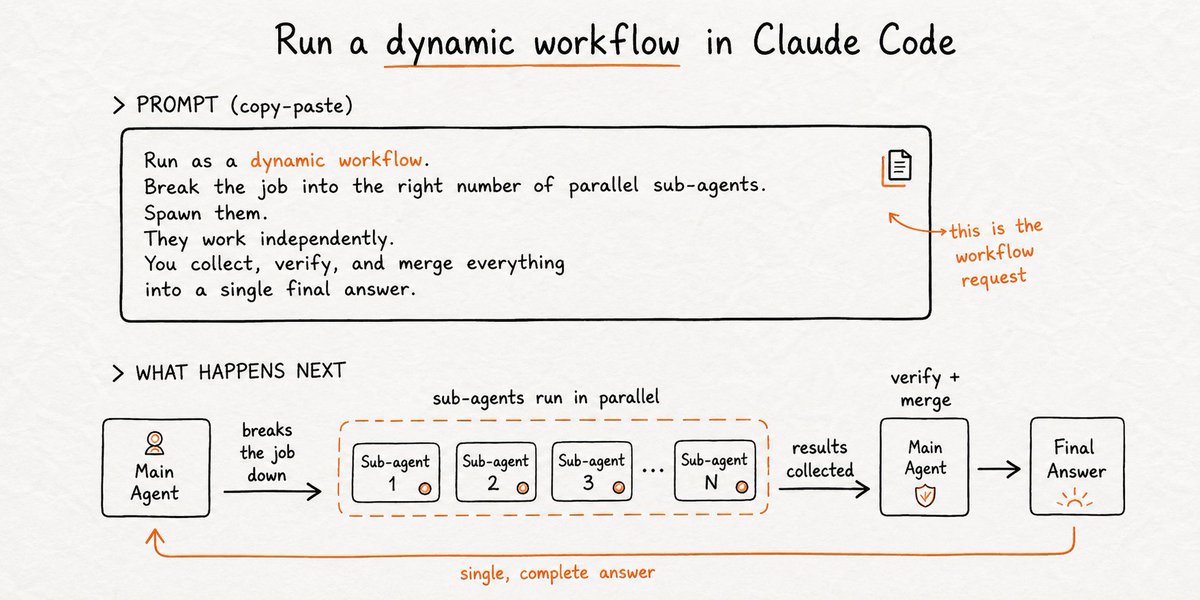
Visual source: Anatoli Kopadze, X.
A responsible first graph for a growing business
Do not begin with a large autonomous fleet. Start with one process that is recurring, bounded, and measurable.
A suitable first candidate could be a weekly market scan, lead qualification brief, content research pack, support-ticket classification workflow, or pre-meeting account preparation process. The workflow should have a defined trigger, a small set of expected inputs, clear outputs, and a human owner who can assess whether the result was useful.
Use this first implementation checklist:
- Name the outcome. Define the business decision or deliverable the workflow must improve.
- Map the current process. Write down each step, its input, output, owner, and tool.
- Remove artificial dependencies. Apply the dependency test and identify safe parallel work.
- Specify contracts. Make each node return a predictable structure rather than unbounded prose.
- Add controls. Define what needs verification, who approves external actions, and what happens when evidence is missing.
- Set cost and time caps. Limit concurrency, tool calls, and budget for early runs.
- Measure the result. Track turnaround time, rework, exception rate, quality of output, and business impact.
- Improve only after evidence. Scale the graph once it has proved useful, not because it appears technically impressive.
The practical takeaway
Graph engineering gives teams a way to move from isolated AI prompts to operationally designed systems. Its advantage is breadth: independent work can happen concurrently, results can be checked deliberately, and a final output can be grounded in more evidence than a single pass can collect.
Its limitation is equally important: a graph does not substitute for leadership, clear inputs, accountable review, or trustworthy source systems. It can widen execution. It cannot manufacture judgment.
The right first move is simple. Draw one recurring workflow. Mark every actual dependency. Remove the waits that exist only by habit. Then add one independent check before the final decision. That is enough to begin building AI operations that are faster, more visible, and easier to trust.
Source and image attribution: This article was independently written by Pratap AI Innovations after reviewing “Graph Engineering explained: what it is, when to use it and when not to” by Anatoli Kopadze on X. The five embedded visual references are attributed to the original X article.
Ready to map a reliable AI workflow for your business? Talk to Pratap AI about turning high-value operations into governed, measurable systems.
Recommended reads
What Should You Use AI Agents For? A Practical Founder’s Playbook
The best way to use AI agents is not to start with models or tools. Start with repeated work, low-value admin, research loops, and personal friction points you already understand, then give agents narrow jobs with clear review steps.
Semantic Memory Substrate: Why AI Agents Need Shared Company State
A company brain is not another app that remembers things. It is a shared semantic memory substrate that lets humans and AI agents work from the same facts, decisions, permissions, and history.